
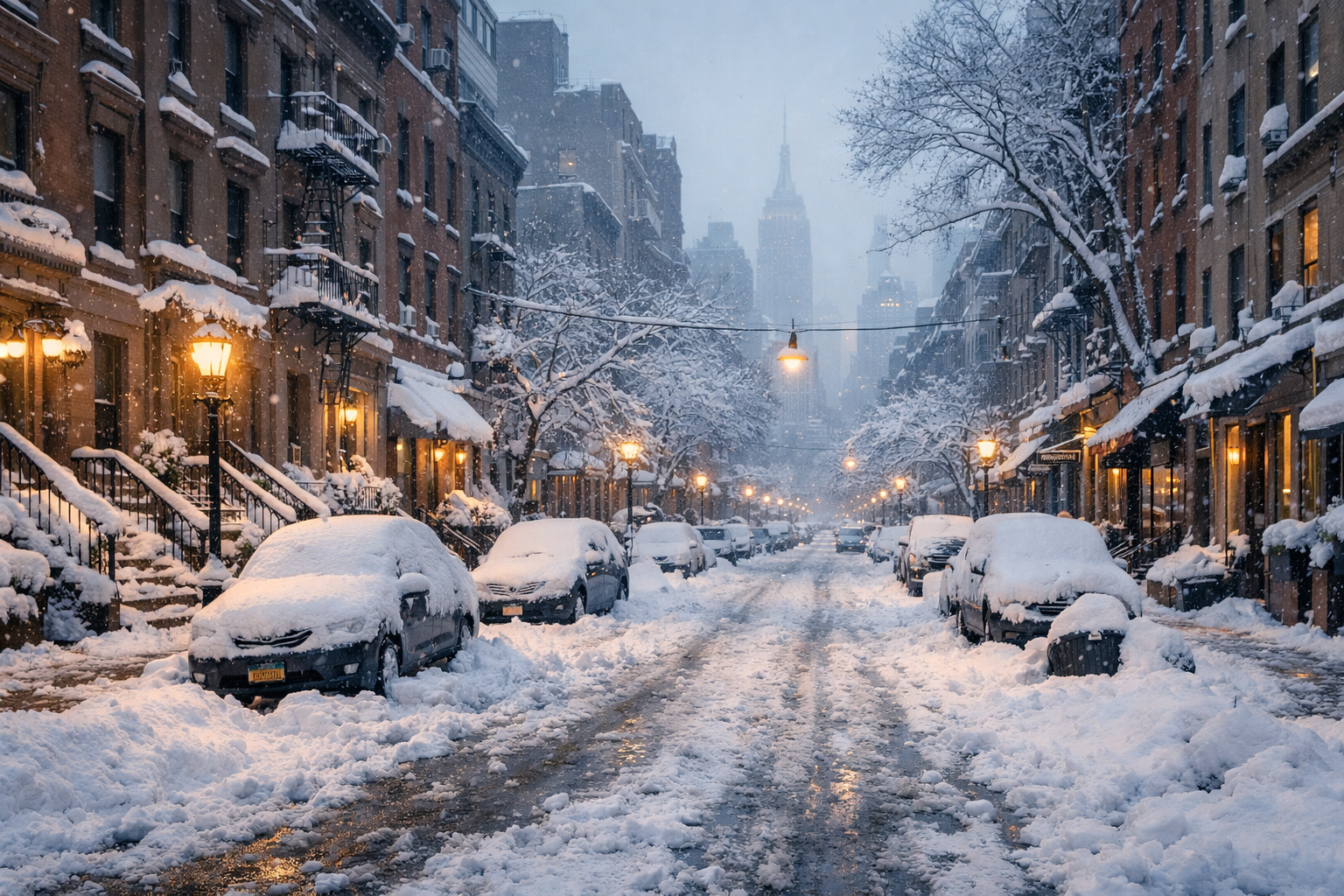
Last weekend, New York City did what it always does when faced with a major snowstorm: it panicked, stalled, and then collectively shrugged.
The snow didn’t just fall — it crippled the city. Streets narrowed overnight. Parking evaporated. What little curb space existed suddenly vanished under mountains of snow that had nowhere to go. Entire neighborhoods woke up to a new reality: 50% fewer parking spots, double-parking chaos, and the unspoken understanding that if you moved your car, you might never find another spot again.
And here’s the part that really gets me:
This isn’t new.
This isn’t rare.
This isn’t unexpected.
We live in a city that has dealt with winter for over a century, yet every major snowstorm still feels like an unsolved mystery.
Let me oversimplify for a second — and I know I am — but if we can do this…
We can create platforms where someone can spin up a full website in minutes.
We can generate images, write code, design apps, and explain a chemistry joke on demand.
We can build skyscrapers that touch the clouds.
We can engineer man-made islands in Dubai shaped like palm trees and world maps.
We can tunnel under oceans, land rockets back on floating platforms, and build cities in the desert.
…but we can’t figure out what to do with snow?
In 2025?
I’m not an inventor.
I’m not an engineer.
I’m not pretending to have the solution.
But I am someone who lives here, drives here, pays taxes here, and watches the same cycle repeat every winter like it’s Groundhog Day with worse parking.
Why is snow still treated like an unmanageable crisis instead of a predictable logistical problem?
Why do we plow it into parking lanes and then act surprised when congestion gets worse?
Why isn’t there a system — melting, compacting, transporting, repurposing — something — that treats snow like the infrastructure problem it actually is?
We compact garbage.
We process waste.
We manage sewage for millions of people daily.
But snow?
Nah. Just pile it up and hope it disappears.
Meanwhile, traffic gets worse. Emergency vehicles struggle. Businesses suffer. Residents lose hours of their lives circling blocks, double-parking, or giving up entirely.
And leadership?
We have a new mayor in NYC. A new administration. New faces, new promises.
Yet during this storm — not once did I see visible leadership stepping in, explaining a plan, addressing residents, or even acknowledging the scale of the disruption. No reassurance. No accountability. No sense of urgency.
Silence.
That silence is loud.
Elon Musk says robots will be common household items within 15 years. We’re talking about AI assistants, autonomous vehicles, smart cities, and fully automated systems becoming normal parts of everyday life.
So forgive me if I find it absurd that we’re still stuck at:
“Where do we put the snow?”
This rant isn’t about one storm.
It’s about infrastructure complacency.
It’s about accepting dysfunction as normal.
It’s about lowering expectations in a city that prides itself on being the center of the world.
New York is supposed to be the city that figures things out.
The city that adapts.
The city that leads.
But last weekend?
It felt like a city overwhelmed by a problem it’s had forever — and still hasn’t bothered to solve.
Something has to change. Not just with snow and ice, but with traffic, planning, communication, and leadership.
Because if we can build islands in the ocean and rockets that land themselves…
We should be able to figure out winter.